-
info
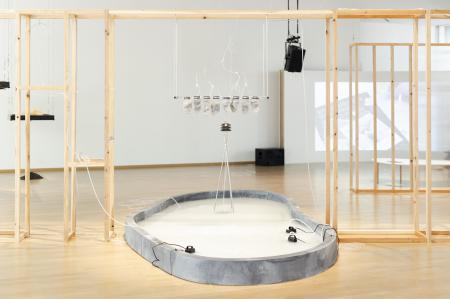
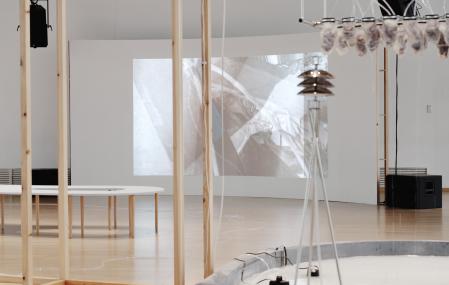
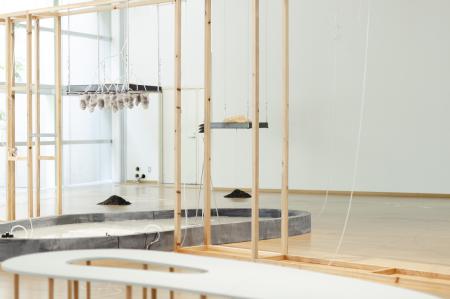
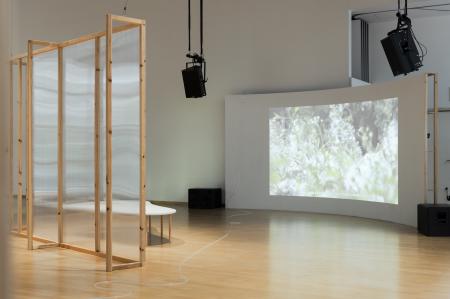
“Ecologies of closeness” is a solo exhibition by Maya Erin Masuda that explores Queer(ed) Ecologies and alternative forms of kinship amid a damaged planet. Alongside Masuda’s spatial installation, the exhibition unfolds over four months through a series of artist talks and workshops. Drawing on Timothy Morton’s concept of “Dark Ecology,” Masuda foregrounds the ambivalent entanglement between ecological intimacy and toxicity, tracin the movements of specific chemicals as they circulat through and across bodies within ecological communities Her inquiry further reveals how broader structura bodies, such as nation-states and institutional authorities, permeate individual bodies, engaging with issues of nuclear biopolitics, reproductive rights, and the pervasive phenomenon of bodily inflammation. Through this lens Masuda’s ongoing engagement with Queer Ecologies articulates a framework for thinking and living with toxicity, resisting regressionist impulses that attempt to negate such dualities “Ecologies of closeness” ultimately calls for an attunement to voices that emerge from complicity, ambiguity, and partial forms of witnessing.
-
") info
“Ecologies of closeness” is a solo exhibition by Maya Erin Masuda that explores Queer(ed) Ecologies and alternative forms of kinship amid a damaged planet. Alongside Masuda’s spatial installation, the exhibition unfolds over four months through a series of artist talks and workshops. Drawing on Timothy Morton’s concept of “Dark Ecology,” Masuda foregrounds the ambivalent entanglement between ecological intimacy and toxicity, tracin the movements of specific chemicals as they circulat through and across bodies within ecological communities Her inquiry further reveals how broader structura bodies, such as nation-states and institutional authorities, permeate individual bodies, engaging with issues of nuclear biopolitics, reproductive rights, and the pervasive phenomenon of bodily inflammation. Through this lens Masuda’s ongoing engagement with Queer Ecologies articulates a framework for thinking and living with toxicity, resisting regressionist impulses that attempt to negate such dualities “Ecologies of closeness” ultimately calls for an attunemen to voices that emerge from complicity, ambiguity, and partial forms of witnessing.
-
 info
single-channel video, color comissioned with YCAM Video link https://vimeo.com/1141621302 Password: please request Living on a wounded planet, the characters in this video ingest chemicals of their own volition and choose to live an unclassifiable queer existence to escape a heterosexual vision of the future dominated by children and reproduction, and conventional gender norms. Drawing on the work of Paul. B. Preciado, Mel Chen and Heather Davis, they engage in a conversation on intimacy and kinship. The redefining of family/kin experienced by queer individuals poses urgent questions around the types of relationship humans choose and/or discard as their communities of care, and what they view as vehicles for succession. Furthermore, by focusing on a scale as microscopic as a molecule, Masuda re-considers various entities such as bacteria, animals, and land as part of a new community, taking clues from the myriad chemical substances that transcend the body and are inherited within the ecological community. We are thus revisiting the idea of a “planetary kinship” that spreads horizontally and is fundamentally different from the kinship based on vertical blood relations.
-
 info
single-channel video, color comissioned with YCAM Video link https://vimeo.com/1141621302 Password: planetinyourskin Living on a wounded planet, the characters in this video ingest chemicals of their own volition and choose to live an unclassifiable queer existence to escape a heterosexual vision of the future dominated by children and reproduction, and conventional gender norms. Drawing on the work of Paul. B. Preciado, Mel Chen and Heather Davis, they engage in a conversation on intimacy and kinship. The redefining of family/kin experienced by queer individuals poses urgent questions around the types of relationship humans choose and/or discard as their communities of care, and what they view as vehicles for succession. Furthermore, by focusing on a scale as microscopic as a molecule, Masuda re-considers various entities such as bacteria, animals, and land as part of a new community, taking clues from the myriad chemical substances that transcend the body and are inherited within the ecological community. We are thus revisiting the idea of a “planetary kinship” that spreads horizontally and is fundamentally different from the kinship based on vertical blood relations.
-
 info
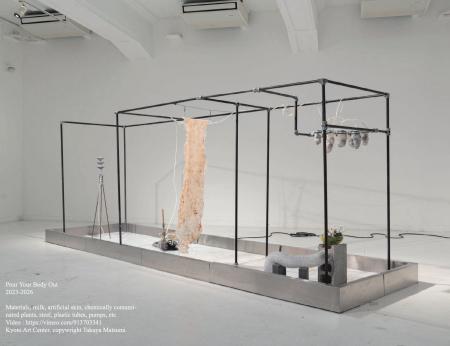
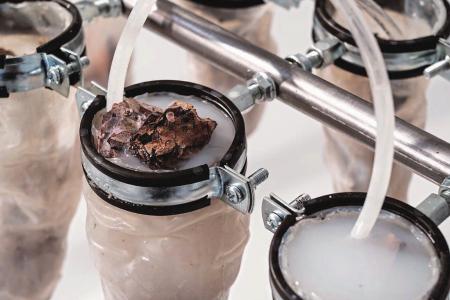
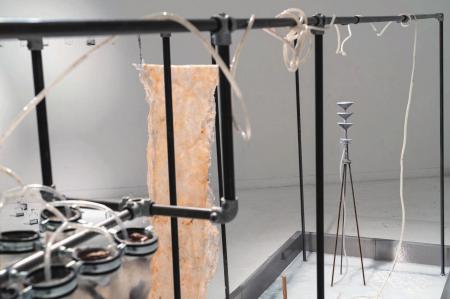
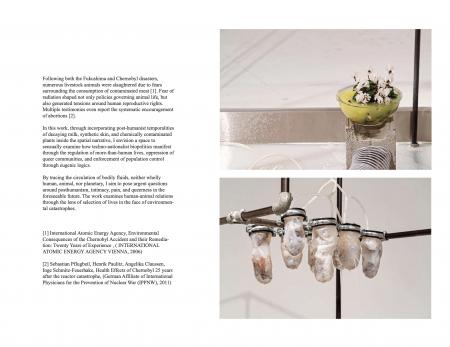
Following both the Fukushima and Chernobyl disasters, numerous livestock animals were slaughtered due to fears surrounding the consumption of contaminated meat [1]. Fear of radiation shaped not only policies governing animal life, but also generated tensions around human reproductive rights. Multiple testimonies even report the systematic encouragement of abortions [2]. In this work, through incorporating post-humanist temporalities of decaying milk, synthetic skin, and chemically contaminated plants inside the spatial narrative, I envision a space to sensually examine how techno-nationalist biopolitics manifest through the regulation of more-than-human lives, oppression of queer communities, and enforcement of population control through eugenic logics. By tracing the circulation of bodily fluids, neither wholly human, animal, nor planetary, I aim to pose urgent questions around posthumanism, intimacy, pain, and queerness in the foreseeable future. The work examines human-animal relations through the lens of selection of lives in the face of environmental catastrophes [1] International Atomic Energy Agency, Environmental Consequences of the Chernobyl Accident and their Remediation: Twenty Years of Experience , ( INTERNATIONAL ATOMIC ENERGY AGENCY VIENNA, 2006) [2] Sebastian Pflugbeil, Henrik Paulitz, Angelika Claussen, Inge Schmitz-Feuerhake, Health Effects of Chernobyl 25 years after the reactor catastrophe, (German Affiliate of International Physicians for the Prevention of Nuclear War (IPPNW), 2011)
-
") info
“Ecologies of closeness” is a solo exhibition by Maya Erin Masuda that explores Queer(ed) Ecologies and alternative forms of kinship amid a damaged planet. Alongside Masuda’s spatial installation, the exhibition unfolds over four months through a series of artist talks and workshops. Drawing on Timothy Morton’s concept of “Dark Ecology,” Masuda foregrounds the ambivalent entanglement between ecological intimacy and toxicity, tracin the movements of specific chemicals as they circulat through and across bodies within ecological communities Her inquiry further reveals how broader structura bodies, such as nation-states and institutional authorities, permeate individual bodies, engaging with issues of nuclear biopolitics, reproductive rights, and the pervasive phenomenon of bodily inflammation. Through this lens Masuda’s ongoing engagement with Queer Ecologies articulates a framework for thinking and living with toxicity, resisting regressionist impulses that attempt to negate such dualities “Ecologies of closeness” ultimately calls for an attunemen to voices that emerge from complicity, ambiguity, and partial forms of witnessing.
-
") info
“Ecologies of closeness” is a solo exhibition by Maya Erin Masuda that explores Queer(ed) Ecologies and alternative forms of kinship amid a damaged planet. Alongside Masuda’s spatial installation, the exhibition unfolds over four months through a series of artist talks and workshops. Drawing on Timothy Morton’s concept of “Dark Ecology,” Masuda foregrounds the ambivalent entanglement between ecological intimacy and toxicity, tracin the movements of specific chemicals as they circulat through and across bodies within ecological communities Her inquiry further reveals how broader structura bodies, such as nation-states and institutional authorities, permeate individual bodies, engaging with issues of nuclear biopolitics, reproductive rights, and the pervasive phenomenon of bodily inflammation. Through this lens Masuda’s ongoing engagement with Queer Ecologies articulates a framework for thinking and living with toxicity, resisting regressionist impulses that attempt to negate such dualities “Ecologies of closeness” ultimately calls for an attunemen to voices that emerge from complicity, ambiguity, and partial forms of witnessing.
Websites
Portfolio Website
mayamasuda.netSocial media
Curriculum vitae
Education
-
2026 - 2029Researcher at MAR (Meaningful Artistic Research) Utrecht, HKU faculteit Kunst en Vormgeving
-
2021 - 2023MA in Arts and Humanities Royal College of Art, Londen diploma
-
2019 - 2021BA in Arts and Media Tama Art University, Tokyo, Japan diploma
-
2017 - 2019(Trasfer) Information Design and Engineering Keio University, Tokyo
exhibitions
-
2025Ecologies of Closeness Yamaguchi Center for Arts and Media Yamaguchi, Japan “Ecologies of closeness” is a solo exhibition by Maya Erin Masuda that explores Queer(ed) Ecologies and alternative forms of kinship amid a damaged planet. Alongside Masuda’s spatial installation, the exhibition unfolds over four months through a series of artist talks and workshops. Drawing on Timothy Morton’s concept of “Dark Ecology,” Masuda foregrounds the ambivalent entanglement between ecological intimacy and toxicity, tracin the movements of specific chemicals as they circulat through and across bodies within ecological communities Her inquiry further reveals how broader structura bodies, such as nation-states and institutional authorities, permeate individual bodies, engaging with issues of nuclear biopolitics, reproductive rights, and the pervasive phenomenon of bodily inflammation. Through this lens Masuda’s ongoing engagement with Queer Ecologies articulates a framework for thinking and living with toxicity, resisting regressionist impulses that attempt to negate such dualities “Ecologies of closeness” ultimately calls for an attunemen to voices that emerge from complicity, ambiguity, and partial forms of witnessing. www.ycam.jp/en/events/2025/scopic-measure-17/ Solo
-
2025Sleep, Lick, Leak, Deep... Daiwa Foundation London London , United Kingdom The Daiwa Anglo-Japanese Foundation is pleased to present Maya Erin Masuda’s first UK solo exhibition, Sleep, Lick, Leak, Deep….. Through an understanding of the precarious nature and fluxes of the planet we reside in, Masuda suggests alternative, imaginative forms of more-than-human entanglements that embrace ambiguity, multiplicity, and the queer. In her body of work, Masuda takes an intimate look at contemporary ecological traumas and biopolitics seen in particular chemical infrastructures or nuclear catastrophes. Born in Tokyo and based in London and Berlin, Masuda has often likened skin, the highly personal, physical and emotional boundary which living beings possess, to the national, necropolitical borders artificially constructed by human societies. For Masuda, her research trips to ecologically damaged sites are a liberating experience, deconstructing the discrepancy between an institutionalised human-planetary exploitation and her own sensations, brought about by finding the unbearable ecological intimacy embedded within. In this exhibition, Masuda thus provides a poetic, ontological breath which fosters a sense of interspecies belonging and points to the non-autonomous essence of all living agents. dajf.org.uk/exhibitions/sleep-lick-leak-deep-by-maya-erin-masuda Solo
-
2025Transmediale 2025 Haus der Kulturen der Welt (HKW) Berlin, Germany In response to transmediale's 2025 theme, this year’s research workshop, organised by the Digital Aesthetics Research Center (Aarhus University) in collaboration with transmediale, reflects on how current networked, technological environments are designing, capturing, and capitalising on ways of being social. The workshop’s title references a quote from Uruguayan poet Cristina Peri Rossi stating painfully that, “in love as in boxing, everything is a matter of distance”. Throughout two days, the workshop led by part of the DARC team Pablo Velasco, Magdalena Tyzlik-Carver, Søren Pold, Christian Ulrik Andersen, Nicolas Maleve, and Jussi Parikka – will relate to the temporalities of always-on and FOMO, to the aesthetics as ways of sensing distance and proximity and to the possibilities for resistance and critique. During the festival, participants will share their work in progress in a collective presentation. Featuring work by Minke Nouwens, Ruben van de Ven, Megan Phipps Christoffer, Koch Andersen, Tommy Shaffer Shane, Sami Itavuori, Matīss Groskaufmanis, Maja Funke, Katya Sivers, Daria Iuriichuk, Kola Heyward-Rotimi, Nico Daleman, Paul V. Schmidt, Maya Erin Masuda. transmediale.de/en/event/darc-phd-presentation-2025 Group
-
2024SOFT & HARD: Beyond Recognition and Queer Coding Art House Wakefield Wakefield The Art House welcomes Whiskey Chow, a London-based artist, Chinese drag king, and Tutor at the Royal College of Art (RCA), who brings together a group of artists exploring what ‘Queer spirit’ means in artistic practice today. Living in different timelines of LGBTQIA+ movements, and constantly negotiating with complex power dynamics from intersectional and cross-cultural perspectives, Queer artists often invent new visual approaches to address their desires and concerns. SOFT & HARD investigates how new generations of Queer artists create space for themselves and their community through art that goes beyond vanity, hypersexuality and gender performativity. The exhibition features recent RCA graduate artists Elena Hoskyns-Abrahall, Emma Sheehy, Hongmin An, Jim Rampage, Leonie Cameron, Net Warner, Sean Synnuck, Sojung Park, Yuqing Lin, Candice Dehnavi, Maya Erin Masuda, Theresa Weber, Rose Arbuthnott and Whiskey Chow. the-arthouse.org.uk/exhibitions/whiskey-chow-curates-soft-hard-ii/ Group
-
2023Ground Zero Kyoto Art Center Kyoto, Japan Ground Zero is a term originally utilised to describe the site of a nuclear explosion or rocket detonation. The term, which has been used since the Manhattan Project, has been appropriated today to describe the loss of a bright future and the "empty space" that came at a cost. The recent wars and invasions seen on the earth has not only caused massive human suffering, but has also left behind enormous consequences including the contamination of forests, land, and animals through the use of weapons of mass destruction. What has been lost is not only physical and material. International rejection and cancellation has resulted in the disappearance of specific local cultures and histories from the complex web of relationships in human memory and cyberspace. Here, the "geotrauma" is expanding from the physical world of topography to form a void in the intangible realm of culture and memory. By investigating how the latest technology such as satellite surveillance or nuclear energy contributed to this new form of biopolitics, the exhibition considers the material/immaterial void spaces created in these peripheries as the new ground zero of our time, and collectively share the memory of this trauma. www.kac.or.jp/en/events/%E5%B1%95%E8%A6%A7%E4%BC%9A%E3%80%8Eground-zero%E3%80%8F/ Group
-
2023Constructing Utopia Gallery xy Olomouc Olomouc, Czech Republic There is no bright future: instead, there are many utopian scenarios that have some similarities alongside the differences. Some of them are based on new social practices, while others recontextualise architectural or scientific ideas. However, this or that utopian model is purely individual. At the same time, there is another side to the coin. Behind the happy image of the future one always can find oppressed social groups, unfair distribution of resources, and other issues. In this context, the word "utopia" is often associated with the word "dystopia" (which is an antonym). It can be quite difficult to draw a clear distinction between them. The word "utopia" has a Greek origin. It is formed from two words: from oὐ ("not") and τόπος ("place"). It is usually used in the context of unrealistic dreams about the future. However, in terms of the exhibition, it is not a place or something static, but also a process, an idea, an event, an experiment, a movement of thought, a hypothesis, and a fantasy. This project is a laboratory. Here artists, like scientists, try to predict how reality will change in the near (or not so-near) future. These forecasts are speculative and individual. Some of the artists believe that the new world will be based on collective memory, others explore its ecological aspects, and others represent the future world in the context of feminist, technocratic, and other theories. The artists in this exhibition do not offer a realistic vision of the future but show its (im)possible trajectories. sites.google.com/a/xyolomouc.com/galerie/page/galerie-xy/2023-constructing-utopia Group
Commissions
-
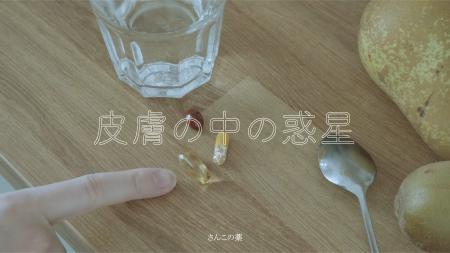
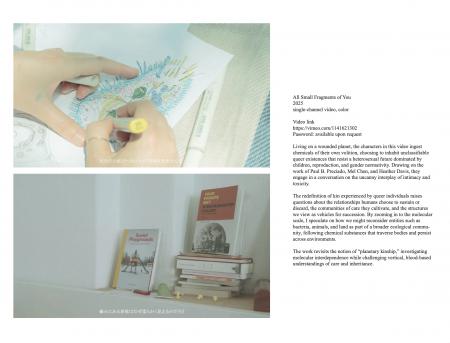
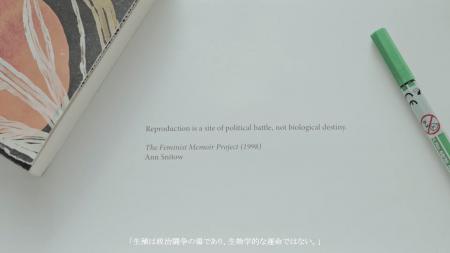
2025Planet in Your Skin Yamaguchi Center for Arts and Media Yamaguchi, Japan single-channel video, color comissioned with YCAM Video link https://vimeo.com/1141621302 Password: please request. Living on a wounded planet, the characters in this video ingest chemicals of their own volition and choose to live an unclassifiable queer existence to escape a heterosexual vision of the future dominated by children and reproduction, and conventional gender norms. Drawing on the work of Paul. B. Preciado, Mel Chen and Heather Davis, they engage in a conversation on intimacy and kinship. The redefining of family/kin experienced by queer individuals poses urgent questions around the types of relationship humans choose and/or discard as their communities of care, and what they view as vehicles for succession. Furthermore, by focusing on a scale as microscopic as a molecule, Masuda re-considers various entities such as bacteria, animals, and land as part of a new community, taking clues from the myriad chemical substances that transcend the body and are inherited within the ecological community. We are thus revisiting the idea of a “planetary kinship” that spreads horizontally and is fundamentally different from the kinship based on vertical blood relations. mayamasuda.net/Planet-in-Your-Skin-All-Small-Fragments-of-You finished
reviews
-
2025Exploring the Relationship Between Reproduction and Technology from the Perspective of Queer Ecology: An Interview with Maya Erin Masuda Magazine Natsuko Fukushima Tokyo, Japan www.tokyoartbeat.com/articles/-/maya-erin-masuda-interview-202508 Interview on Maya Erin Masuda by Natsuko Fukushima, editor in chief, Tokyo Art Beat.
-
2025Toxic Queer Bonds: “Toxicity” and the “Other” in the Work of Maya Erin Masuda Magazine Nodoka Odawara Tokyo, Japan realtokyo.co.jp/exhibition/maya-erin-masuda-ecologies-of-closeness/ Review on Maya Erin Masuda's solo exhibition 'Ecologies of Closeness 'by Nodoka Odawara, professor of Yokohama National University.
-
2025Interview with Maya Erin Masuda: How Do We Live with “Invisible Toxicity” and “Violence Through Delay”? Magazine Meruro Washida Tokyo, Japan bijutsutecho.com/magazine/interview/31368 Interview on Maya Erin Masuda by Meruro Washida, the director of 21st century museum, Kanazawa.
Awards and grants
-
2025Ezoe Memorial Foundation Scholarship Ezoe Memorial Foundation Tokyo, Japan Maya Erin Masuda has been a fellow from Ezoe Memorial Foundation Scholarship since 2021-2025 for research abroad.
-
2024Kuma Foundation Scholarhship Kuma Foundation Tokyo, Japan Maya Erin Masuda has been a fellow from Kuma Foundation since 2021-2024 for artistic research and production.
-
2024Sasakawa Grant Sasakawa Foundation London Maya Erin Masuda has been a recipient of Sasakawa Grant for the year of 2024 for artistic research and production.